
Foster Care Is Not About Replacing Families. It's About Restoring Them.
- bchfamily

- May 15
- 6 min read

Every May, we recognize Foster Care Awareness Month. But at BCH, awareness was never the finish line — action is. This week, we're going deeper into one of the most misunderstood truths about foster care: that the goal was never replacement. It was always restoration.
A Prayer From the Very Beginning
When Malik first came to live with his foster family, they didn't pray for adoption. They prayed for something harder — and more beautiful.
They prayed that he would feel safe. That he would experience the love of Jesus in their home. And that one day, he would carry that love back to his own family.
"We always hoped that he would feel safe in our home," they shared, "and that one day his home would be a safe place for him to return to."
From the very first day, they knew their role was temporary — and they were okay with that. Because they understood something that more people need to hear: foster care is about restoration, not replacement.
Rooting for the "Other" Parents
One of the most countercultural things a foster family can do is root for the biological parents.
And that's exactly what Malik's foster family did.
They made it clear from the beginning — to Malik's parents, and to themselves — that they were not there to take his place in the family. They were there to hold space while his parents did the work they needed to do.
"We made it very clear to his parents from the beginning that we would love him as our own, care for him as our own, fight for him as our own," they said, "but that we were rooting for them to do what needed to be done to bring him home."
Practically, that looked like weekly connection calls between visits. Sending pictures. Asking Malik's parents about his preferences and how to care for him well. Having real conversations — not just about Malik, but about them, as people, as parents, as a family.
"We always checked with them about decisions regarding Malik," they shared. "We always sent pictures and remained super engaged with them."
But engagement alone wasn't enough. They had to go deeper — into the harder work of the heart.
"It took work on our part to reach out consistently, to not judge where they were at or how they got there — probably the hardest part — but instead to love them right where they were and respect them as his parents."
That meant sitting with discomfort. It meant having difficult conversations when they didn't see eye to eye, working toward understanding even when agreement wasn't possible. It meant choosing, again and again, to see Malik's parents not as obstacles but as people — his people.
That kind of intentional relationship doesn't happen by accident. It is chosen, daily, even when it's hard.
Fighting for Family — Even When It Was Complicated
What does it look like in practice to advocate for a child's biological family? For Malik's foster family, it looked like going out of their way — repeatedly — to make space for connection that the system didn't always make easy.
When Malik's first birthday with them arrived, they didn't just celebrate within their own four walls. They advocated for his parents to be part of it.
Visits at the time were supposed to be supervised at the DSS office. But his foster family pushed for something different — and DSS agreed, as long as they promised to supervise. So they did. They hosted his parents at his birthday party that first year, supervised the visit themselves, and gave Malik something the system rarely makes room for: a birthday with his whole family present.
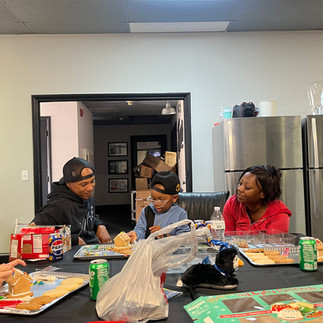
That Christmas Eve, they supervised a visit at their church and even set up a Christmas tree there. One big family, opening gifts and decorating cookies together. Malik's parents even brought presents for the foster family's children.
And after Malik was reunified with his biological parents, they continued the relationship with his foster family.
"They always allow him to text and call us anytime," his foster mom shared. "They've never told him he can't talk to us."
That generosity — from parents who had every reason to feel threatened — is its own kind of grace.




When the Gospel Became Visible
Something else was happening in Malik's home during that season. He was coming to know Jesus.
For his foster family, it was the answer to their deepest prayer.
And then came a moment that none of them will ever forget.
Malik and his biological father were baptized together.
"What stood out the most to me in that moment was just the pure joy on Malik's face as he got to watch his father be baptized," his foster mom shared. "The joy on both of their faces afterwards was worth everything."
She still cries when she thinks about it.
"It was literally a picture of the gospel and the heart of the Father — seeing us reunited with Him. It truly captured the beauty of God's heart for restoration and wholeness."
A father and son. Stepping into water. Coming up new.
That's not just a beautiful moment. That's what foster care, at its best, makes possible.
The Both/And of Letting Go
Reunification is the goal of foster care. Legally. Practically. And — for families of faith — spiritually.
But knowing that doesn't make it easy.
When the day finally came for Malik to go home, his foster family felt the full weight of both joy and grief at the same time.
"We went through the full spectrum of emotions for sure," they said. "So much joy, happiness and pride knowing that everything we'd all been working towards was coming to pass. But also sadness and grief as we knew thatmeant letting him go."
They had talked for a long time about what it would look like to stay connected after reunification — while also holding that loosely.
"We always told ourselves that we would completely understand if they decided that wasn't going to work for them," they shared. "We prayed that the Lord would just give us strength to handle however it turned out, and to keep our eyes fixed on the picture of His heart He showed us through their baptism moment."
That kind of surrender — loving fully while holding loosely — is not natural. It is learned. It is prayed for. And it is one of the most profound things foster care asks of a family.
What Success Really Looks Like
Ask most people what a "successful" foster care story looks like, and they'll describe an adoption.
Malik's family sees it differently.
"The goal is always reunification when safe," they shared, "and as foster parents, if we don't recognize that as success, then we are missing the point completely."
And today, the fruit of that posture is visible.
Malik has a baby sister. He plays soccer. He runs to his biological parents on the sidelines after games — and still introduces his foster brothers to his coach as his brothers.
Two families. One story. Both made whole.
"Seeing Malik with his family today is the most beautiful thing," his foster mom said. "We get to see the fruit of obedience and feel the joy that it brings."
And when she reflects on all of it — the hard conversations, the birthday parties, the Christmas Eve visits, the tears, the baptism, the letting go — she doesn't have a tidy summary. Just gratitude.
"I could go on and on," she said. "It really is so special for us to have been able to have this experience with them. Unfortunately it's not always our story, but we are so grateful."
What This Means for You
Foster care is not about finding children for families. It's about finding families for children — temporarily, prayerfully, sacrificially — while biological families are given the chance to heal.
It doesn't always end in reunification. Not every story looks like Malik's. But the posture — that every child belongs first to their family, and that restoration is worth fighting for — should shape every foster family from day one.
If you've been thinking about foster care but weren't sure you could love a child and let them go, hear this:
"None of our kids are really ours to begin with. Every child entrusted to you — whether through biology or through a journey like fostering, kinship, or adoption — is yours by the grace of God. Your job is to love them fiercely while you can, and trust God with the rest of their story."
That's the call. That's the yes.
Are you ready to say it?